+86 15093323284 hams@ailunce.com




How Does Cross Band Repeat Work | Signal Flow Explained
1. Introduction
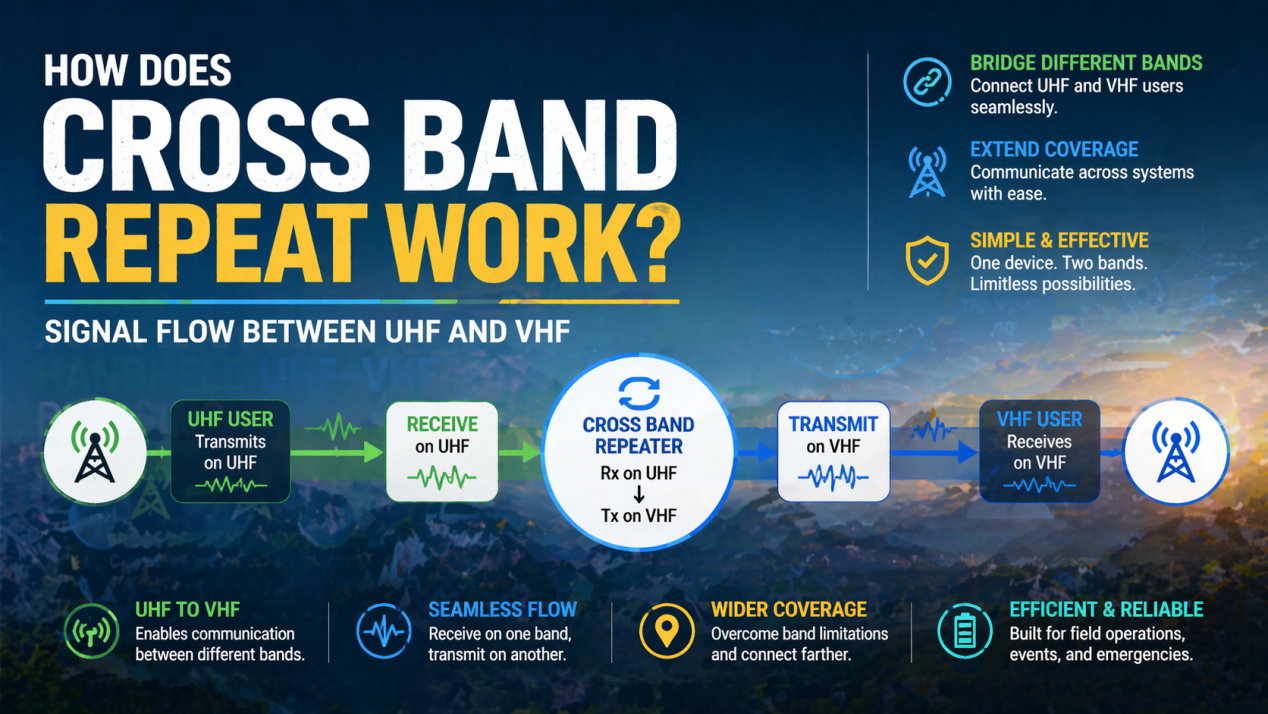
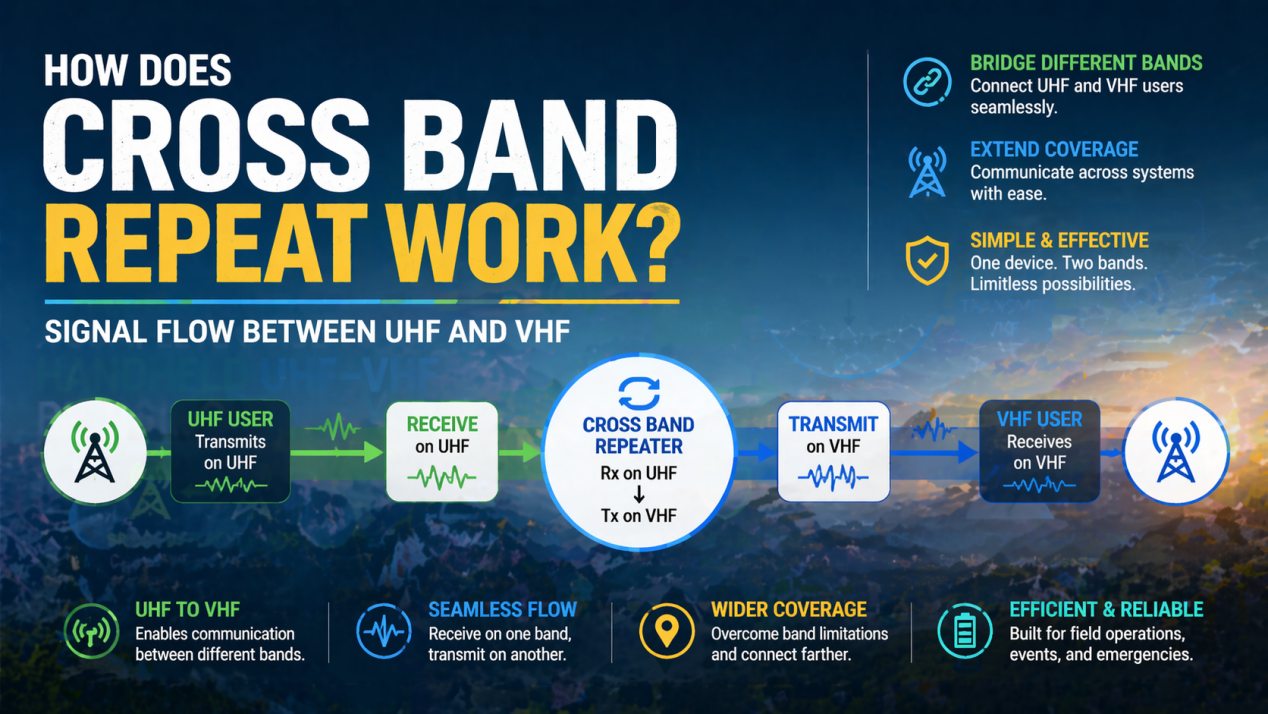
The core task of cross band repeat is simple: take a signal received on one band and retransmit it on another band. However, this seemingly simple process involves several technical details in practice.
This article will explain how cross band repeat works based on real-world experience and industry practices, including two different setup methods, duty cycle considerations, and what makes handheld devices different in this scenario.
2. Basic Workflow of Cross Band Repeat
2.1 Core Steps
The work of cross band repeat can be summarized in the following steps:
|
Step |
Description |
|
Receive |
Receive a signal on Band A (e.g., UHF) |
|
Evaluate |
Check if the signal meets trigger conditions (e.g., tone match) |
|
Retransmit |
Transmit the signal on Band B (e.g., VHF) |
This process is automatic. The user needs to pre-configure the frequency parameters for both bands, and the device automatically completes the forwarding when a signal is received.
2.2 Basic Prerequisite
Cross band repeat has a basic prerequisite: both communication links must work properly when used individually.
Specifically:
The handheld radio and the relay device must be able to communicate normally
The relay device and the distant repeater must be able to communicate normally
If either link does not work on its own, enabling cross band repeat will not solve the problem. This is why industry guidelines recommend testing each link individually before enabling cross band repeat.
3. Two Setup Methods and How They Work
Based on real-world experience, there are two common ways to set up cross band repeat. They work differently and apply to different scenarios.
3.1 Method 1: Two-Way Full Repeat
How it works:
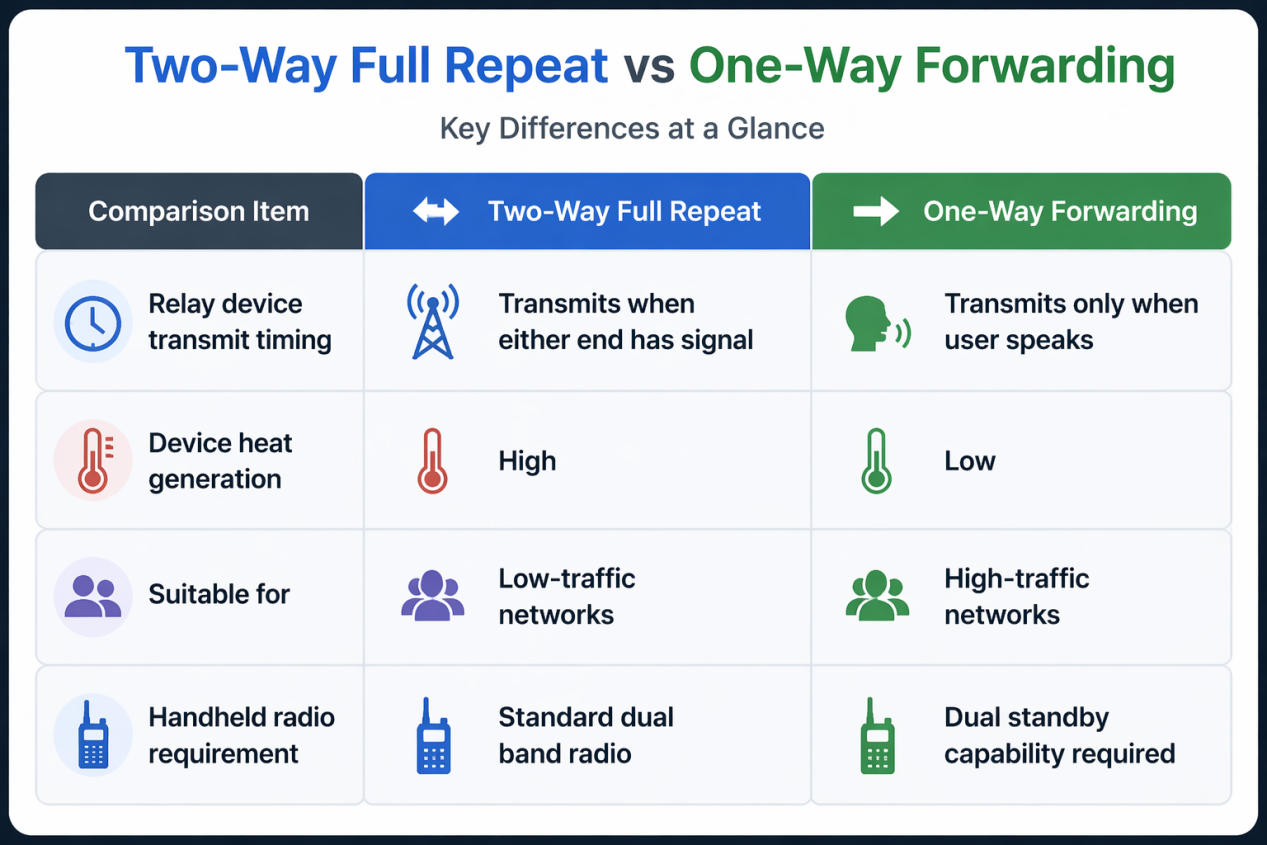
In this setup, the relay device forwards all signals from both ends:
When the handheld radio transmits, the relay device forwards its signal to the distant repeater
When the distant repeater has a signal, the relay device forwards it to the handheld radio
The problem:
When the distant repeater is busy, all incoming traffic from the repeater is forwarded through the relay device to the handheld radio. This means the relay device transmits for very long periods — extremely high duty cycle.
Real-world case:
During a bicycle marathon event, an operator used this method. Because the repeater was very busy, his device overheated and shut down after continuous high-intensity operation, leaving him completely unable to communicate for nearly 30 minutes.
3.2 Method 2: One-Way Forwarding
How it works:
In this setup:
Two-way communication is maintained between the handheld radio and the relay device
Between the relay device and the distant repeater, the relay device only transmits when the user speaks
Return signals from the distant repeater are received directly by the handheld radio, not through the relay device
Requirement:
This setup requires the handheld radio to support dual standby — the ability to monitor two channels simultaneously:
Channel A: Communication with the relay device
Channel B: Direct reception from the distant repeater
Advantage:
This method significantly reduces the relay device's transmit duty cycle. The device only transmits when the user speaks, greatly reducing heat generation and power consumption.
3.3 Comparison of the Two Methods
4. Duty Cycle in Cross Band Repeat Operation
Duty cycle refers to the proportion of time a device spends transmitting relative to total operating time.
In normal communication mode, the device only transmits when the user presses PTT, resulting in a typically low duty cycle. In cross band repeat mode, however, the situation changes.
According to industry technical documentation: cross band repeat doubles the device's duty cycle. When the relay device is connected to a busy repeater, it transmits frequently, forwarding all repeater traffic to the handheld radio.
Consequences of excessive duty cycle include:
Increased device heat generation
Faster battery consumption
In severe cases, overheating and shutdown
Mitigation measures: Use the minimum necessary power and consider using one-way forwarding to reduce device load.
5. Prerequisites for Cross Band Repeat Operation
5.1 Equipment Requirements
Cross band repeat requires a dual band radio. However, it is important to note that not all dual band radios support cross band repeat functionality.
Devices that support cross band repeat typically have the following features:
Two independent VFOs (frequency oscillators)
Ability to configure parameters for both bands separately
Firmware support for cross band forwarding
5.2 Tone Configuration
Using tones (CTCSS/DCS) effectively prevents false triggering by unrelated signals. In cross band repeat scenarios, it is recommended to enable tone encode/decode on both ends.
The role of tones is that only signals carrying the correct code can trigger the cross band repeat device, preventing noise or other unrelated signals from activating the device.
6. RETEVIS RA89R: What Scenarios It Addresses and What Problems It Solves
After understanding how cross band repeat works, a natural question arises: what handheld device can reliably perform this task in real-world scenarios?
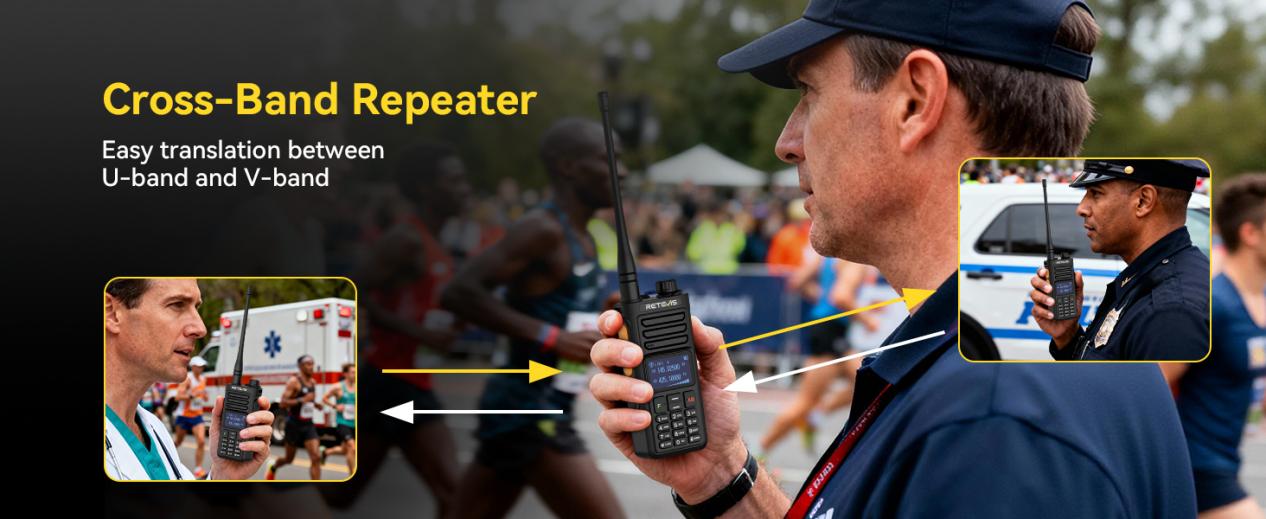
The RETEVIS RA89R is a dual band handheld radio that supports cross band repeat functionality. Below is a focus on what problems it solves and what scenarios it is used in.
6.1 Core Problems Solved
|
Problem |
RA89R Solution |
|
Team has both UHF and VHF devices that cannot communicate directly |
Automatically forwards signals between the two bands, allowing both sides to communicate without changing equipment |
|
No fixed repeater available on site |
Serves as a temporary repeater, quickly establishing a communication bridge |
|
Handheld radio lacks sufficient power to reach a distant fixed repeater |
Extends communication range through cross band forwarding via a mobile rig or higher-power device |
|
Rapid deployment needed for emergency communication |
Handheld device is ready to use out of the box — no antenna installation or wiring required |
6.2 Typical Use Scenarios
Scenario 1: Multi-Agency Joint Operation
During an emergency response, the fire department uses UHF equipment while the medical team uses VHF equipment. Under normal conditions, the two departments cannot communicate directly.
After deploying an RA89R in cross band repeat mode:
UHF device signals are received by the RA89R
The RA89R automatically forwards them on the VHF band
VHF devices can now hear the other side
Users on both ends require no additional steps — it feels like talking on the same band.
Scenario 2: Outdoor Team Activity
On a hiking trip, some team members use UHF radios while others use VHF radios. The team leader carries an RA89R and places it at a high point (hilltop, tree branch) as a temporary repeater.
Regardless of which band each team member uses, they can all stay in communication through the RA89R's relay.
Scenario 3: Signal Dead Zone Coverage
In large buildings or valleys with poor signal reception, an RA89R can be placed at a location with good signal (e.g., near a window, at a high point) to forward signals into the dead zone, solving the problem of "having a device but receiving no signal."
Scenario 4: Temporary Cross-Department Coordination
At a large construction site or industrial campus, the security department uses UHF equipment while the engineering department uses VHF equipment. The central dispatch room uses an RA89R as a cross band repeater, enabling unified dispatch and rapid response across both departments.
6.3 Core Value
The RETEVIS RA89R allows users to bridge UHF and VHF with a single handheld device, seamlessly connecting different radio systems. It does not require the high power or complex installation of a mobile rig — it is ready to use out of the box.
For users who need to connect different teams and handle complex communication scenarios but cannot rely on fixed repeaters or mobile rigs, the RA89R offers a portable, rapidly deployable solution.
7. Summary
The working process of cross band repeat can be summarized as: Receive signal → Evaluate conditions → Forward across bands.
Key takeaways:
Two setup methods: Two-way full repeat and one-way forwarding — choose based on network traffic
Duty cycle: Cross band repeat doubles the device's duty cycle — pay attention to heat dissipation and power control
Prerequisites: Both communication links must work properly on their own
Equipment choice: The RA89R is a handheld cross band repeat solution suitable for multi-agency coordination, outdoor activities, emergency communication, and other scenarios
Understanding how cross band repeat works helps with proper device setup, avoiding common problems, and making better choices in real-world use.